Madison College is putting an educational twist on a campus food pantry to help students battling food insecurity.
Students can grab up to ten pounds of food per week, but it’s about more than just free food. The goal of the pantry is to educate about nutrition and encourage students to eat healthy on and off campus.
“I’m not going to be working for the next month or two and I was just getting a little nervous wondering how I was going to make ends meet,” Diana Lynn Craine, Madison College Student said.
Craine said me worrying about classes and graduation is stressful enough, but adding food insecurity to the list makes her job as a student that much harder.
“If I didn’t eat then I’d get hungry and wouldn’t be able to study as well,” she said.
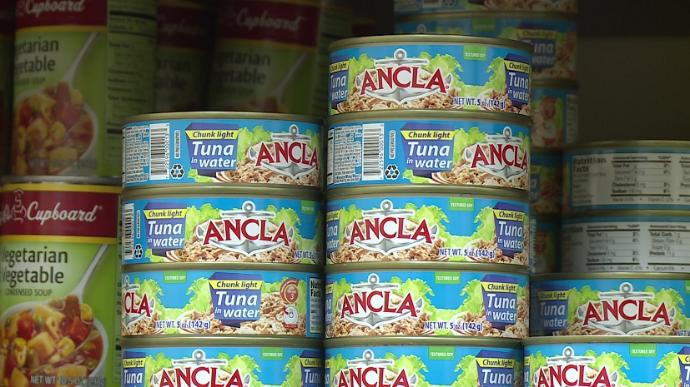
Madison College took notice of the growing problem that’s impacting campuses across the country so they started an educational food pantry where students can take food and knowledge from the Cupboard Truax Campus Food Pantry.
“It’s just phenomenal. It’s been very helpful. I don’t know how I would have gotten by in the next couple weeks,” Craine said.
The pantry is open Tuesdays and Wednesdays for a couple hours a day. Recipe ideas line the shelves of food items that are a healthy variety of breakfast, lunch and dinner.
“It’s just been wonderful. You know your regular staples. You have noodles and fruit,” Craine said.
It doesn’t stop there. After you grab food from the food pantry, you can bring it to the meal planning session to learn how to cook and shop on a budget.
“The thing that I’m most excited about in regards to this is the good and cheap cookbook, ” Emily Noon, Madison College Student said.
Students have the opportunity to ditch the Ramen and upgrade to foods cooked in a brand new crockpot also available in the pantry to take home.
They can listen to tutorials on the most affordable ways to grocery shop and gain a food resource guide stacked with budget friendly recipes
Noon said she’s doing her best to soak in tips to not break the bank when money is tight.
“That’s amazing. Next semester is going to be so different for me. I know I’m going to save so much money because of it,” she said.
The pantry has had nearly 300 visits since it opened in September. Pantry organizers said they are hoping to see that number climb in an effort to help students in need.
Tis the season of the weird drink. Or, at the very least, the season of the drink you’d never usually touch. Eggnog and mulled wine are just the beginning. There are labs full of white-coated product developers working to bring you such Heston Blumenthal-by-way-of-Willy-Wonka festive excess as M&S’s Trifle Flavour Cream liqueur – a twist on Baileys that draws out the classic molecular gastronomy response-sequence: “Wow, it tastes like trifle”, “How did they do that?”, “Why did they do that?”
Still, let’s not be too much of a Scrooge. I’m not the target market for pudding-based cream liqueurs although, at a certain point on Boxing Day, I wouldn’t rule out a thimbleful of the slightly less sickly Mince Pie Flavour Cream.
I am, however, very much the prime target for another of what for most of us is an annual event, but which is – as I tell myself every Christmas – just as much fun at other times of the year. Port remains one of the wine world’s great bargains: the quality of the dark, velvety Taylor’s Late Bottled Vintage Port 2013, the figgy, nutty Tesco Finest 10 Year Old Tawny Port or the silky, mature Taste the Difference Vintage Port 2000 – far outstrips any equivalently priced light wine. And they’re better with chocolate and stilton, too.
Perhaps only sherry can match port for value, and trump it for range: from a briskly salty-savoury-yeasty aperitif such as Waitrose Manzanilla Pasada El Benito to the molasses-like Morrisons The Best Pedro Ximenez – a wine that could itself be marketed as a trickery-free Christmas cake liqueur.
The sheer sweet raisiny intensity of PX sherry also makes it a good match for the Christmas pud, although not as good a combination as my now-favourite Christmas pairing: Christmas pudding and bourbon. Maybe there was something in the spice mix in our family’s pudding last year but the fudge and cinnamon flavours of Maker’s Mark Kentucky Straight Bourbon were in perfect harmony.
That whiskey also matched the mood it was primarily bought to enhance: that feeling of after-dinner cosiness that is for me the whole objective of Christmas. This year, I have my eye on the dusky apple goodness of Henry de Querville Fine Calvados and the super-spicy and fruity Japanese blended whisky Nikka from the Barrel as candidates for ushering me towards that same precious, drowsy moment.
Pedro’s Almacenista Selection Palo Cortado Sherry Jerez, Spain NV Super dry and powerfully flavoured, this example of sherry’s most unusual style, palo cortado, is beautifully done: dark, nutty and intensely savoury, and, at 20% ABV it works as a lighter digestif alternative to brown spirits.
The Society’s Exhibition Crusted Port Douro, Portugal, Bottled 2013 Wonderfully satisfying, deep, rich and superb value example of the crusted style of port. A blend of three older vintages (2009, 2010 and 2011) that is designed to taste and feel – look out for the sediment – like a mature vintage port.
Hogwash Blended Malt Scotch Whisky Both Aldi and Lidl have a nice line in affordable whisky, this being quite remarkably flavourful for its price tag. With its sweet spices, citrus and stone fruitiness, it would go well with ginger mixers.
Vivir Tequila Anejo Many of us still associate tequila with shots and the attendant messiness, but the Mexican spirit commands immense respect among aficionados, with this bourbon cask-aged, 100% Blue Weber agave-based sipper a golden, velvet-textured, complex dram.
Baron de Sigognac 10 Year Old Armagnac With its nose of sweet orange blossom honey and vanilla pod, and a rich palate filled with spice and toffee, this armagnac is refined and long without losing the characteristic earthy warming punch of cognac’s wilder, Gascon country brandy cousin.
Doorly’s 12 Year Old Rum Few drinks are as luxuriously and immediately pleasurable as well-made, aged rum such as this excellent golden production from Barbados which is all sticky toffee richness, ripe, ripe fruit and wisps of cinnamon, vanilla and sweetly scented oak.
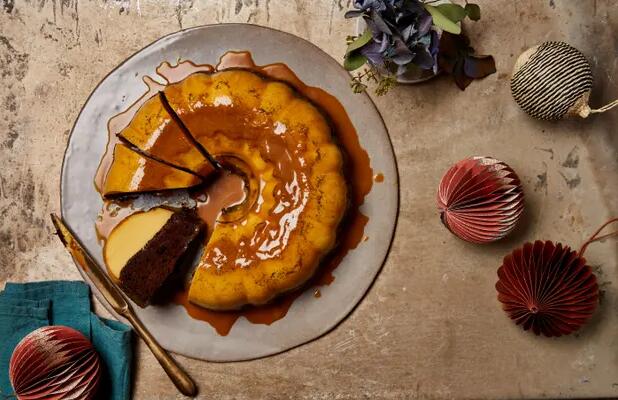
“So bad, it’s good” couldn’t have a more fitting use than for chocoflan, a Mexican dessert that combines two layers of pure decadence in one cake.
Chocoflan There’s a nifty science trick in this recipe, when the cake layer and the flan layer swap positions during the baking. We’ve tested this with different tins without much success, so do make sure you use a 27cm bundt tin that does not have a removable base. I’d recommend making this a day ahead, because it tastes even better when fridge-cold.
Prep 10 min Cook 1 hr 20 min Cool 2 hr-plus Serves 10-12
160g caramel sauce (thick set), store bought or homemade – I used Waitrose salted caramel dipping sauce 1 tbsp whole milk
For the chocolate cake 120g unsalted butter, at room temperature, plus extra for greasing 250g plain flour ½ tsp baking powder ½ tsp bicarbonate of soda 70g cocoa powder ¼ tsp salt 100g dark muscovado sugar 125g caster sugar 2 large eggs 200ml buttermilk
For the flan 1 x 400g tin evaporated milk 1 x 397g tin sweetened condensed milk 120g full-fat cream cheese, at room temperature 3 large eggs 2 tsp vanilla bean paste ¼ tsp salt
Heat the oven to 170C (160C fan)/ 350F/gas 4. Liberally grease a 27cm bundt tin with butter, then coat the bottom with half the caramel sauce and put the tin into a larger roasting tin about 40cm x 28cm in size.
Now start on the cake batter. Sift the flour, baking powder, bicarb, cocoa powder and salt into a medium bowl. Put the butter and both sugars in the bowl of a stand mixer with the paddle attachment in place. Beat on medium speed for about two minutes, until light and fluffy. Beat in the eggs one at a time only until just incorporated, then turn the speed to medium-low. Mix in a third of the flour mixture and half the buttermilk, then repeat before adding the last of the flour. Mix until everything is just incorporated, then transfer to the bundt tin, smoothing out the top with the back of a spoon.
For the flan batter, blitz all the ingredients in a blender until smooth – about 15 seconds. Pour the flan batter over the cake batter in the tin, then cover the bundt tin first with a piece of greaseproof paper and then with a piece of foil, wrapping it up tightly. Add enough boiling water to the roasting tin to come about 2cm up the sides of the bundt tin, then transfer to the oven and bake for an hour, or until a toothpick inserted into the cake comes out almost clean; rotate the tin once after 30 minutes, to ensure an even bake. Lift the tin out of its water bath, remove the foil and greaseproof paper, and leave for about an hour, until completely cool.
Invert the chocoflan on to a large, round platter – you may need to shake it slightly to release it from the tin – then refrigerate until cold, for at least two hours and, ideally, if time allows, overnight. To serve, thin the remaining 80g caramel with the milk and drizzle all over the flan.
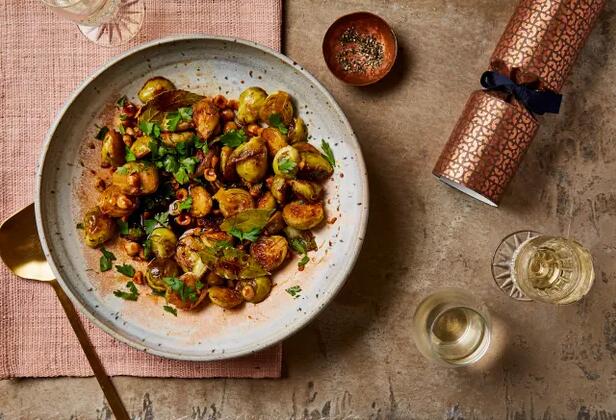
Pan-fried sprouts with bay, soy, hazelnuts and sherry vinegar This is such a delicious way to cook sprouts, and they go beautifully with turkey. If you can, get a good sherry vinegar – it will make all the difference.
Heat a large frying pan over a medium-high heat and, when hot, add the butter and oil. Once the butter starts sizzling, add the sprouts and bay, and shake the pan so the sprouts are coated in the fat. Turn the heat down a fraction and fry for four to five minutes, stirring a few times, until the sprouts begin to colour.
Add the hazelnuts, and toast in the pan for two to three minutes, until everything looks golden, adding a splash of water if anything threatens to darken too much.
Add the soy, sherry vinegar and honey, and stir. Carry on cooking until the liquids have heated through and the sprouts are tender when pierced with a sharp knife.
Serve in a warm bowl scattered with parsley, if you wish.
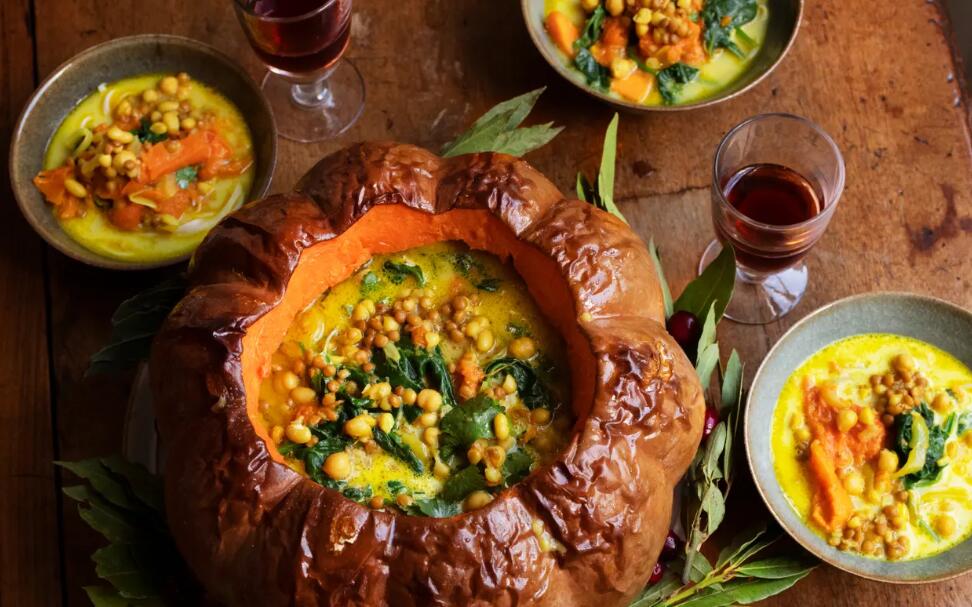
This year’s Christmas dinner will have at its heart a great golden pumpkin, full to the brim with long noodles, lentils and a saffron-coloured sauce of spices and sour cream. There will be a crisp salad, sweet with ripe pears and sour with crunchy pickles; a jewel-like salad of rice, herbs and pomegranates.
The soup-stew can be made in advance and finished at the last minute. Its serving dish – a butter roasted pumpkin – can be eaten too. The pickles can, indeed must, be made a few weeks ahead and can be served as an accompaniment but I have also included them in a salad with ice-crisped sprouts and comice pears.
Nothing will stop me eating the traditional plum pudding, for me the best bit of the feast, but I see every reason to have a few alternatives in store. Which is how I will end up with three desserts this year. A fruit laden pudding; a hot puff pastry tart filled with apples and mincemeat and a festive ice-cream of crimson berries and honeyed nuts. In all, a glittering festive feast.
Pumpkin, noodles, lentils and sour cream A large pumpkin is a splendid sight on the Christmas table, but if that proves impossible then serve the glowing golden soup-stew in a big tureen or deep bowl, ladling it out into bowls. I find the easiest way to deal with the noodles is either to cut them into short lengths before adding them to the stew or to leave them long and lift them out with a pair of kitchen tongs.
Peel the onions. Roughly chop two of them. Thinly slice the others. Warm the olive oil in a large pan set over a moderate heat, add the chopped onions and fry them for 15-20 minutes till soft and pale gold. Peel and thinly slice the garlic, then stir into the onions with the turmeric and continue cooking for a couple of minutes.
Drain the chickpeas and haricots and stir into the fried onions together with the lentils and stock. Bring to the boil, then lower the heat and leave to simmer for 30 minutes, stirring occasionally.
Preheat the oven to 200C/gas mark 6. Melt 40g of the butter in a shallow pan, then add the reserved sliced onions and let them cook slowly, with the occasional stir, until they are a rich toffee brown. This will take a good half an hour, maybe longer.
Cut a lid from the top of the pumpkin, then remove any seeds and fibres from within. Scrape away about a kilo of the flesh using a spoon, taking great care not to tear the skin and leaving plenty of flesh in place so the walls of the pumpkin are thick enough to hold the stew.
Place the pumpkin on a baking tray, put the remaining 50g of butter into the hollow and bake for 30-40 minutes until the flesh is soft and tender. Occasionally baste the inside of the pumpkin with the pool of melted butter.
Cut the reserved raw pumpkin flesh from the pumpkin into large, spoon-sized pieces and add to the simmering stew. As soon as the pumpkin turns translucent, (a matter of eight or 10 minutes) add the noodles. Wash the spinach, put it in a pan set over a medium heat, cover with a lid and leave it for three or four minutes until it has wilted. Turn occasionally with tongs. Remove the spinach and put it in a colander under cold running water until cool. Wring the moisture from the spinach then stir into the simmering stew. Roughly chop the parsley, coriander and mint leaves and stir most of them into the onions and beans.
Carefully ladle the stew into the roasted pumpkin shell, trickle in the soured cream and add the remaining herbs and the fried sliced onions, then ladle into bowls.
Crisp salad of radishes and pickles A couple of weeks before Christmas, I like to make a jar or two of crisp, bright pickles to slice through the richness of Christmas cooking. Not content for them to appear as an accompaniment, I often include them in a salad, tossing them with sweet fruit such as ripe pears and crisp greens such as shredded cabbage or brussels sprouts. This time I have used them with radishes to produce a salad that is hot, sweet, sour and crisp.
Peel the shallots and cut them in half. Peel and trim the beetroot and cut into quarters. Now do the same with turnips, cutting them into similar size pieces as the beetroot. Put them all into a glass storage jar. Pour the hot pickling liquor over the vegetables then seal. Keep in a cool place for a week or so before using.
To make the salad, trim and quarter the sprouts then leave them to soak for 20 minutes in iced water. Peel the pears, core them and cut into thin slices. Put them in a serving dish and splash with some of the pickling liquor to prevent the fruit discolouring. Trim and thinly slice the radishes and mooli. Toss the sprouts, radishes, mooli, pears and pickles together and serve.
Basmati, pistachio and pomegranate A substantial salad, especially one that can be made a few hours in advance, is an incredibly useful thing to have to hand at this time of year. To a pan of aromatic steamed basmati I have added some seasonal treasures, including pistachios and pomegranate seeds. I could have used toasted pine kernels and parsley, or toasted cashews and coriander leaves. The point is to use an equal volume of rice and fresh herbs, nuts and fruits as you might for a tabbouleh – so the salad is vibrant and fresh. You can make this an hour or two in advance but I would be tempted not to introduce the pomegranate until the last minute.
Research has shown that income is increasingly linked to health: Not only are today’s richer Americans healthier than poorer ones, but the gap is wider than it was in the early 1990s. Studies have attributed this to food consumption, with better dietary quality associated with higher socioeconomic status—in other words, the more money you have, the easier it is to afford nutritious foods.
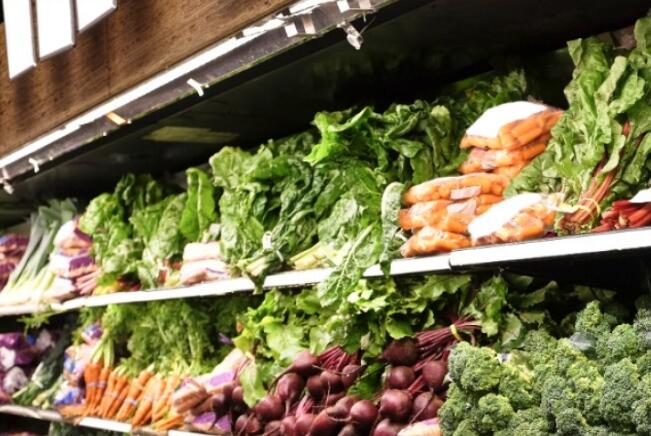
Some have concluded that a key part of the problem is “food deserts”—neighborhoods without supermarkets, mostly in low-income areas. A widely held theory maintains that those who live in food deserts are forced to shop at local convenience stores, where it’s hard to find healthy groceries. A proposed solution is to advocate for the opening of supermarkets in these neighborhoods, which are thought to encourage better eating.
This idea has gathered a lot of steam. Over the past decade, federal and local governments in the United States have spent hundreds of millions of dollars encouraging grocery stores to open in food deserts. The federal Healthy Food Financing Initiative has leveraged over $1 billion in financing for grocers in under-served areas. The Healthy Food Access for All Americans Act, which is currently under consideration in Congress, would extend these efforts with large tax credits. Meanwhile, cities such as Houston and Denver have sought to institute related measures at the local level.
Former First Lady Michelle Obama articulated this proposed remedy quite clearly: “It’s not that people don’t know or don’t want to do the right thing; they just have to have access to the foods that they know will make their families healthier.”
However, recent research in the Quarterly Journal of Economics, co-authored by Hunt Allcott, an associate professor in the Department of Economics, raises questions about the efficacy of this approach. He spoke with NYU News about food deserts and how they may—or may not—improve nutrition.
How did you examine the impact of food deserts on nutrition—and the value of opening supermarkets in areas that lacked them?
Between 2004 and 2016, more than a thousand supermarkets opened nationwide in neighborhoods around the country that had previously been food deserts. We studied the grocery purchases of about 10,000 households in those neighborhoods. While it’s true that these households buy less healthy groceries than people in wealthier neighborhoods, they do not start buying healthier groceries after a new supermarket opened. Instead, we find that people shop at the new supermarket, but they buy the same kinds of groceries they had been buying before.
Your findings seem to challenge the conventional wisdom on this topic. How so?
These results shouldn’t be too surprising: basic economic logic of supply and demand had foreshadowed our result.
The food desert story is that the lack of supply of healthy foods in food deserts causes lower demand for healthy foods. But the modern economy is more sophisticated than this explanation allows for—grocers have become amazingly good at selling us exactly the kinds of foods we want to buy. As a result, our data support the opposite story: lower demand for healthy food is what causes the lack of supply.
Many backers of this “food desert story” point to distances many must travel to find healthier food options, making geography a barrier to better nutrition. Is there any validity to this claim?
There isn’t much support for this explanation. The average American travels 5.2 miles to shop, and 90 percent of shopping trips are made by car. In fact, low-income households are not much different—they travel an average of 4.8 miles. Since we’re traveling that far, we tend to shop in supermarkets even if there isn’t one down the street. Even people who live in zip codes with no supermarket still buy 85 percent of their groceries from supermarkets.
So when a supermarket opens in a food desert, people don’t suddenly go from shopping at an unhealthy convenience store to shopping at the new healthy supermarket. What happens is, people go from shopping at a far-away supermarket to a new supermarket nearby that offers the same types of groceries.
Do new supermarkets or grocery stores bring any benefits to communities?
Absolutely. In many neighborhoods, new retail can bring jobs, a place to see neighbors, and a sense of revitalization. People who live nearby get more options and don’t have to travel as far to shop. But we shouldn’t expect people to buy healthier groceries just because they can shop closer to home.
What, then, is your advice to policy makers?
We need to first rethink current practices addressing the vital concern of nutrition. Government agencies and community organizations devote a lot of time and money to “combatting food deserts,” hoping that this will help disadvantaged Americans to eat healthier. Our research shows that these well-intended efforts do not have the desired effect. One thing that definitely does work is taxing unhealthy foods such as sugary drinks, and we’ve been looking at that in other research.
One of our country’s main challenges is to build an inclusive society in which people from all backgrounds can live happy and healthy lives. We hope that this research can give some insight on what works and what doesn’t.
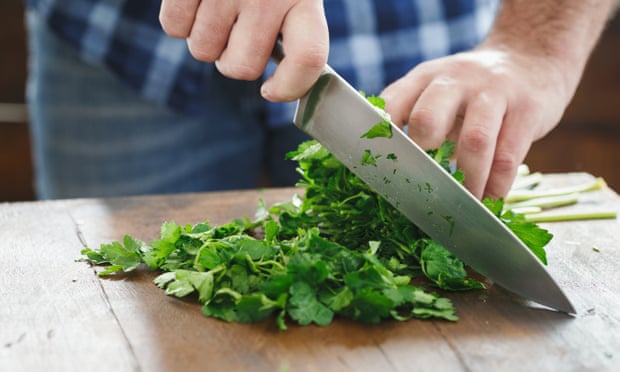
It depends mainly on whether you want to keep your fingers attached to your hands, Erica. Chef Mark Birchall, whose restaurant Moor Hall near Ormskirk in Lancashire was last week voted the UK’s best at the annual National Restaurant Awards, likens his knives to a toolkit: “No one reaches in and picks out the same screwdriver for every DIY job, do they?” he says bluntly. “You just can’t fillet a fish with the same knife you use to chop parsley.”
But that doesn’t mean you have to go to town on the knife collection, Birchall says. “You need a short, stiff knife [AKA a chef’s knife] for general everyday stuff, from chopping veg to trimming a rack of lamb, for example. A long, flexible blade for boning meat and filleting or skinning fish. And a serrated one for bread.” If you want to push the boat out, “a paring knife is handy for prep and peeling, but it’s not essential”, he adds.
The big drawback is cost – Birchall favours US brand Mac (from about £90 for a basic chef’s knife), Japanese Missono (£150-plus) or a reliable German marque such as Wüsthof or Henckels (£80-100) – but he reckons a comparatively cheap Victorinox (from about £24) will do the job just as well: “You’d be surprised how many chefs use those day-to-day.”
He says that the type and brand is less important than a knife that’s properly sharp and feels comfortable in the hand – and that applies to a domestic kitchen as much as to a professional one. “You’re far more likely to slip and injure yourself with a blunt knife than a scarily sharp one.” As for comfort, that’s more personal preference: “I don’t like a chef’s knife that’s too light, especially if I’m stood there chopping for hours at a time. You end up gripping it too tightly and end up with terrible hand-ache.”
Some of the cooks in Birchall’s kitchen keep 10 or more blades in their knife rolls: “Chefs can get a bit obsessive about them,” he laughs, “but most only ever use those three main types, no matter how many they own. A lot of it’s just willy-waving.”
Talking of knife spods, food writer Tim Hayward has penned an entire book on the subject, called Knife – well, obviously (the paperback edition came out at the end of last month). It’s a love letter to the kitchen knife in general and to his own extensive collection especially. Hayward has a particular soft spot for Japanese knives, on both aesthetic and practical grounds. “They have this special vegetable knife, an usuba, a sort of long, narrow chopper,” he says, “because the way they traditionally cut veg, there’s no need for a sharp point. They also have dedicated knives for fish [deba and yanagiba] and meat, the gyuto or ‘cow blade’.”
But even Hayward, who runs Cambridge bakery Fitzbillies as a sideline to the day job, agrees that there’s no need to go overboard: “If you want to take the skin off fish fillets, it’s a good idea to have a knife with a flexible blade, and if you’re cutting through bone or cartilage in meat, you’ll need a cleaver, but with those two exceptions, for a western cook, a decent 8in or 10in chef’s knife will do just about everything else.”
And anyway, the notion of combining knife styles in a single blade is catching on even in Japan: “They now make a knife called a santoku, which means ‘three strengths’,” Hayward says. “It looks much like a western chef’s knife and is considered suitable for all three food types: veg, fish and meat.”
He won’t reveal how many blades he owns, but it possibly rivals John Lewis’ kitchen department. And, at the end of the day, it’s up to you (and your budget) whether you choose to hop down that particular rabbit hole.
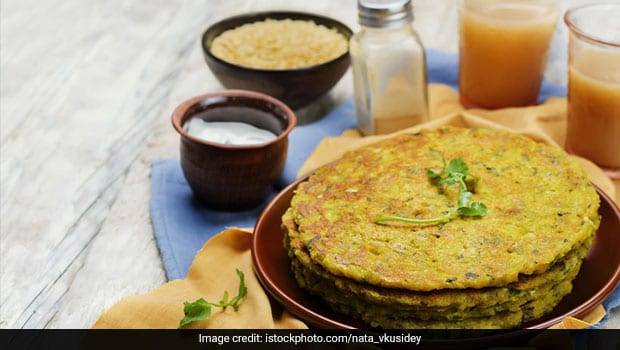
Morning nutrition is foisted with inescapable ironies. Our body demands heavy nutrition during the morning but there is little time to prepare lavish meals amid all the rush and hurry. It’s a tricky task to prepare quick meals with maximum nutrition. Of all the healthy, easy-to-make breakfast dishes, cheela is an all-time winner. It is nutritious, delicious and light on the stomach, and can be made in a jiffy. It is usually made of besan (gram flour made of chickpeas), which is a healthy, gluten-free flour stacked with lots of fibre and other nutrients. It requires little oil to cook and can be topped with onions, paneer, tomato, coriander leaves etc. for a flavoursome treat. It can also be rolled up to be eaten on-the-go during those rushed mornings.
Health experts all over the world are talking about the importance of including protein in diet, especially, if you are trying to lose weight. Protein provides the much-needed energy to make up for the loss of energy during regular physical activities and workout sessions. The best time to have proteins is in the morning so that the body is ready to take on the impending physical and mental load. It’s wise to add proteins to your breakfast diet and here’s an amazing way to do so with your regular besan cheela – add palak (spinach) to it.
Spinach is replete with proteins and other vital vitamins (vitamin A and vitamin K) and minerals like iron, magnesium, potassium and also folates and carbohydrates. Spinach is a wholesome food that covers a major part of body’s nutritional needs.
Recipe Of Besan Palak Cheela
Ingredients –
1 cup besan
1 cup spinach leaves, chopped
1 onion
1/3 cup water
Half tablespoon ginger garlic paste
1 teaspoon jeera (cumin seeds)
A bunch of (dhania) coriander leaves
1 green chilli
Salt to taste
Oil/ghee/butter of your choice
Method of preparation –
Step 1. Put the spinach in a blender or mixie and grind it till it turns into a paste.
Step 2. In a bowl, put besan flour and add water to it. Increase or decrease the amount of water to get the right consistency. It should not be too thick or too thin; it should be a lump-free, smooth paste.
Step 3. Add jeera, onions, chilli, ginger-garlic paste, salt and spinach. Blend well.
Step 4. Heat about 1 teaspoon of oil/ghee/butter on a non-stick pan (tawa) and spread it evenly.
Step 5. Take a large tablespoon of the besan batter and pour it in the middle of the pan. Now, with the backside of the tablespoon, spread the batter in a circular motion all over the pan.
Step 6. Cook on both the sides. Repeat the steps to make other cheelas with the remaining batter.
Garnish this cheela with coriander leaves and serve with mint chutney or tomato sauce. The palak besan cheela is a perfect breakfast meal loaded with nutrients and delectable flavours.

 Food around the world